Notes from a live board
Why the game turns before the winning move
Most games do not turn on the stone that completes five. They turn earlier, when one player leaves a loose pair alone because it does not look urgent. A few moves later that pair meets another line at an empty point. Blocking one threat leaves the other one open, and the finished five is only the last frame of a story that started two or three turns before.
That is the gap this board is meant for. You can play against the computer, or hand the device to someone next to you. When a game ends, undo, hint, and replay are there so you can walk the position backward instead of guessing which stone mattered.
Look past the row in front of you
A row of three is easy to notice. The harder part is seeing the empty intersections around it. On a 15×15 board, a useful stone can belong to a horizontal line today and a diagonal line later. A stone near an edge has fewer options. A stone near the middle can still be part of four different directions, which is why early play drifts toward the centre even when nobody is quoting theory.
If you only watch the nearest stones, you will keep answering the loudest threat and miss the quieter one forming one file over. Stronger play is usually boring in the moment: you spend a turn taking an empty crossing that does not look like an attack yet, then the next two moves suddenly become forced for the other side.
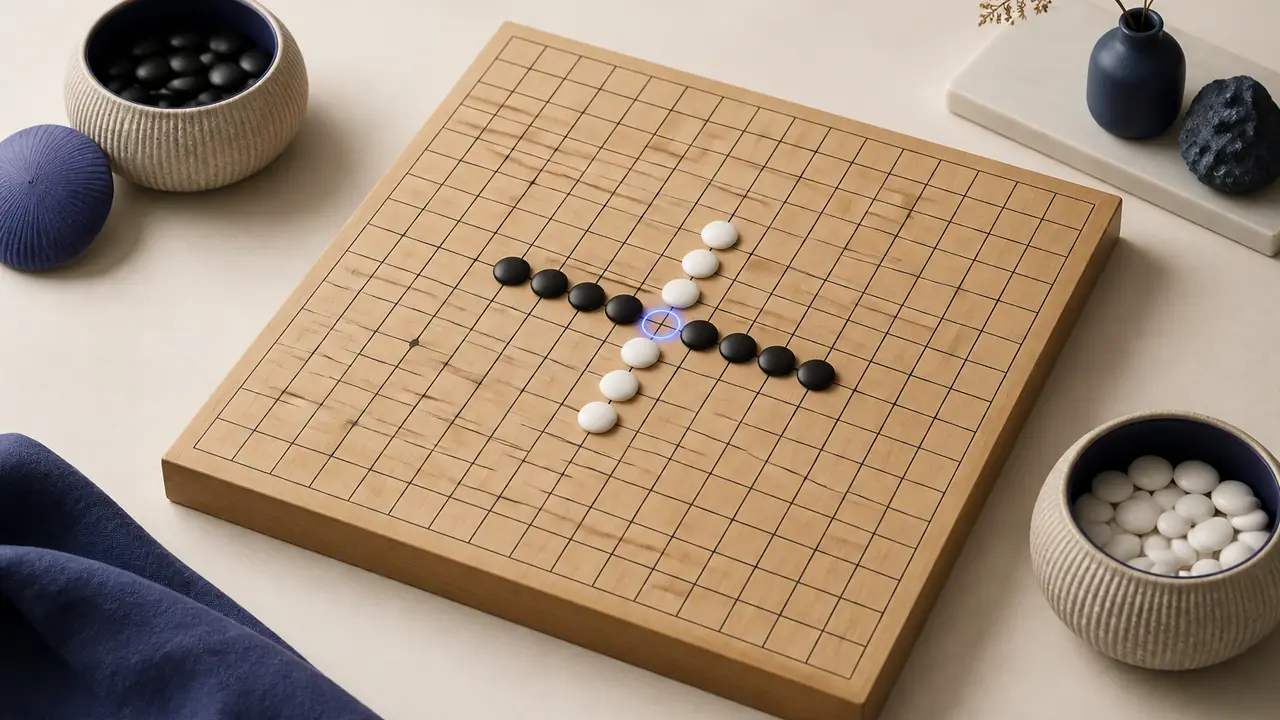
That is the practical difference between counting stones and reading a position. An open three needs attention. An open four must be blocked. A double threat gives the defender two necessary blocks and only one turn. The strongest moves are often the ones that create a threat while also making the next threat easier to build — not the ones that make the neatest row on the board.
Do not extend every line
A common early mistake is extending the nearest pair every time. It makes your plan clear and lets the other player block at the obvious end. Sometimes the better move is one space away: it keeps the pair useful, adds a diagonal possibility, and asks your opponent to decide what they are defending against. If they guess wrong, your next stone is the one that joins both plans.
The same habit shows up in defence. People block the stone that just landed and ignore the empty point where two older pairs can meet. By the time both threes appear, the fork has already been played. The useful check is one layer earlier: if two of their groups share an empty intersection, that intersection is often worth more than continuing your own short row.
“Before you extend a row, check whether the same stone can also start a second line.”
Review the position where it changed
Use replay after a loss, but do not start with the final five. Go back to the first move that forced a reply. Then look at the board one turn earlier. Which pair was ignored? Which empty point linked two groups? That is usually the decision worth remembering for the next game. A hint can suggest a candidate move; replaying the sequence shows why the candidate mattered.
Start with the double-threat notes
Diagrams for open threes, open fours, and the positions that create two threats at once.
A small freestyle board on gomokupro.com: no account, no timer, and enough room to think one move further.